The Seam That Refuses to Fail: Britain's Hand-Stitched Leather Tradition

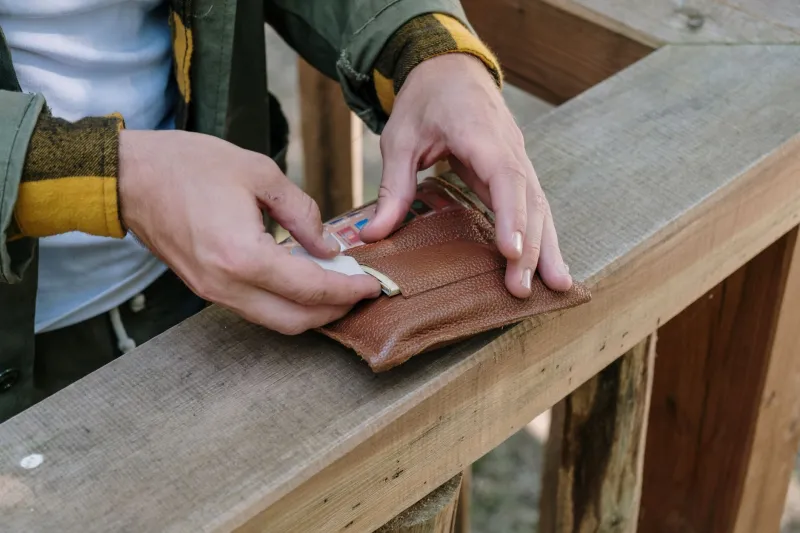
Photo: close-up hand saddle stitching leather workshop needles waxed thread, via img.freepik.com
Hand saddle-stitching is not a decorative flourish. In a British leather workshop, it is the difference between a seam that merely holds and a seam that is designed to be repaired. The technique is older than the factory floor: two needles, one waxed thread, and a rhythm passed from saddler to saddler over centuries. In 2026, when much leather is assembled by machine in minutes, the saddle stitch remains a deliberate act of resistance — and a practical one.
Two needles, one lock
The saddle stitch uses a single length of thread with a needle at each end. The maker passes one needle through the hole, then the other from the opposite side, pulling each stitch tight in turn. The result is a line of stitches that lock against themselves. If a machine seam breaks, the failure can run; if a saddle stitch breaks, the damage tends to stay local. That distinction matters most where leather is asked to work: bag handles, belt loops, strap anchors, the stress points of a satchel or a bridle.
British saddlery has understood this for longer than most of us have been buying jackets. In Walsall, where the leather trade still carries the memory of bridles and harness, the saddle stitch is not heritage decoration. It is the standard for any seam that must tolerate load, weather and repair. A bridle made for a working horse cannot rely on a seam that unravels at the first snapped thread.
How to identify a hand-stitched seam
A hand saddle-stitched seam has a particular look, though it is not always obvious at a glance. The stitches often sit at a slight angle, like tiny leaning posts. The two faces of the leather may show slightly different stitch patterns, because the maker is working from both sides. The tension is even but not mechanical; you may see the small irregularities of a human hand, provided they are consistent and tight.
Machine stitching tends to be flatter and more uniform, with a single visible thread path and a bobbin thread underneath. It can be perfectly good — many excellent jackets are machine-sewn — but it behaves differently when damaged. A hand-stitched seam usually has ends that are backstitched by hand and buried between layers, rather than finished with a visible row of machine backstitching. If you are inspecting a bag or belt in a shop, turn the item over. Look at the reverse side. Ask what the seam is expected to do. A decorative seam on a jacket pocket is not the same as the seam holding a bag handle.
Why it survives repair
Repair is where the saddle stitch earns its keep. A skilled leather mender can cut a damaged stitch, open the seam, replace a panel or strap, and re-stitch through the original holes. The lock of the saddle stitch means the rest of the seam does not need to be unpicked wholesale. Machine seams can be repaired too, but the process is often less forgiving: the original holes may be stretched, the thread may be finer, and the seam may have been constructed in a way that assumes the whole panel will be replaced.
For a jacket, this matters at the side seams, cuffs and pocket mouths, though most jacket seams are rightly machine-sewn for drape and speed. For a bag, it matters at the handle roots, the gusset and the strap anchors. For a belt, it matters at the keeper and the tip. These are the places where a repair should be possible without the item looking like a patchwork. A saddle-stitched seam gives a mender options.
What the extra labour buys
The labour is real. Hand saddle-stitching is slower than machine sewing, and it demands training. A maker must learn to keep tension consistent, to wax the thread, to size the stitch to the leather, and to finish the ends so they do not work loose. That labour is part of what you pay for in 2026. It is not a guarantee of immortality. Leather still scuffs, linings still wear, zips still fail. But it is a guarantee of repairability at the seams that matter most.
Not every leather item needs a saddle stitch. A lightweight jacket, a soft pouch, a fashion scarf — these can be beautifully made with machine seams. The question is where the load sits. If a seam is structural, if it anchors a handle or a strap, if it is likely to be repaired rather than discarded, the saddle stitch is the better answer. Britain still has makers who can do it, and menders who can work with it. That is not nostalgia. It is a practical inheritance, and in 2026 it is still worth asking for.