Before the Card Comes Out: The Case for Deliberating Over Leather Like Our Grandparents Did
Photo: Steve Shook from Moscow, Idaho, USA, CC BY 2.0, via Wikimedia Commons
There is a photograph in many a British family album that tells the same quiet story: a couple at a kitchen table, a catalogue open between them, a pot of tea going cold as they deliberate. A coat. A trunk. A clock for the mantelpiece. These were not decisions made in a moment, and they were certainly not made alone.
We have been thinking about that photograph a great deal lately, because the way Britain buys has changed beyond recognition. A jacket that once required a train journey to a provincial tailor, a fitting, and a fortnight of family discussion can now be ordered between the kettle boiling and the toast going down. The friction has gone — and with it, we suspect, something rather valuable.
The Dinner Table as a Board of Directors
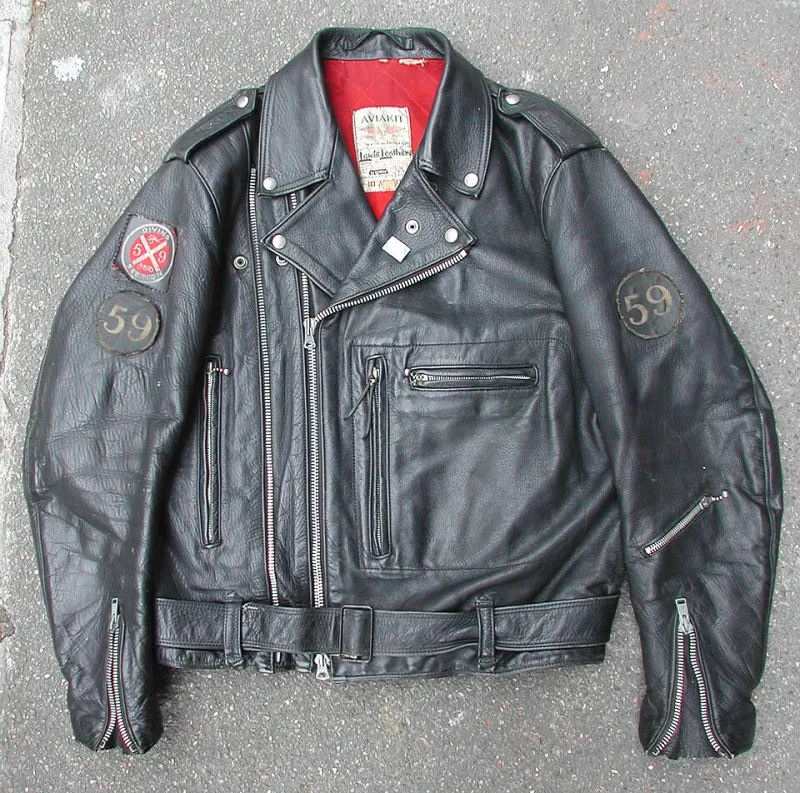
It is worth remembering that for most of the twentieth century, a good leather coat represented a serious outlay. In households where a working man might earn several pounds a week, a quality hide jacket could consume a month's wages. It was not merely a garment; it was a household asset, and household assets were governed collectively.
The consequence was a natural quality control. A husband dazzled by a shop window would be asked, over the evening meal, the sort of level-headed questions that impulse is expert at dodging. Do we need it? Will it last? What does it replace? Children learned, by osmosis, that well-made things were considered investments and that cheap things were considered, in the old phrase, dear at any price.
That dinner-table debrief was, in its way, a more rigorous test than any algorithm. It knew your history. It knew the roof that needed fixing. It knew that you already owned a coat you rarely wore.
What One-Tap Checkout Costs Us
None of this is nostalgia for its own sake. The modern checkout is engineered to remove exactly the pause in which good judgement lives. Saved cards, one-click ordering, next-day delivery — every innovation in retail convenience has been aimed at the same target: the gap between wanting and having.
But leather punishes haste in a way few materials do. A poorly chosen jacket is not a disposable error like a misjudged paperback. It sits in the wardrobe, a monthly reproach, too good to give away and too wrong to wear. Cheap leather, bought quickly, cracks within seasons. The wrong cut of a fine hide, bought for the wrong reasons, never quite feels like yours.
And yet the remedy is not complicated. It does not require a return to mail-order catalogues. It requires only that we reintroduce deliberation — deliberately.
A Framework for the Deliberate Purchase
We would offer three questions, best asked aloud to a partner, a friend, or — failing that — honestly to oneself over that same pot of tea.
First: what does it replace? A purchase justified by addition alone deserves scrutiny. A leather jacket bought because the old one has genuinely failed is a different proposition from one bought because a photograph on a screen looked appealing at half past ten at night. If nothing is being replaced, ask why the wardrobe has a gap — or whether it does.
Second: would a craftsman be proud of it? Turn the description over. Where was the hide tanned? Is the lining stitched or glued? Is there a maker's name willing to stand behind the work? A purchase that cannot survive these questions is not yet ready to be made. A reputable leather house will answer them gladly; a disreputable one will answer them vaguely.
Third: will it be worn in February? British weather is the great honest editor of wardrobes. The jacket that thrills in a sunlit product photograph must still earn its keep against a sleeted platform in Carlisle or a damp Tuesday in Cardiff. Imagine the item in the least flattering month of the year. If it still earns its place, it is a candidate. If not, it was a mood, not a purchase.
The Two-Week Cooling Rule
Then there is the matter of time. We recommend what might be called the two-week cooling rule: identify the piece, note the price, and walk away for a fortnight. If the desire has faded by the time the kettle has cooled, the money has been saved. If the desire has matured into genuine resolve — if you have thought about the weight of the hide, the give of the leather at the elbow, the way it would sit over a Donegal tweed — then you are no longer shopping on impulse. You are acquiring something.
Two weeks also does something the checkout never can: it allows the household to be consulted. Not for permission, necessarily — this is not 1953 — but for perspective. The people who share your hallway will notice if you never wear it. They will also, more usefully, remember the coat you already own that you have been meaning to have repaired.
Craft Deserves Consideration
There is a final point, and it is one we feel keenly. A vegetable-tanned hide represents months of work before it reaches a cutting table — the husbandry, the tannery, the patience. The hands that make a proper leather jacket are working to a standard measured in decades, not seasons. To buy such a thing in the same spirit as a takeaway order is a small discourtesy to the entire chain of craft behind it.
Deliberation, in other words, is not merely financial prudence. It is a form of respect — for the maker, for the material, and for your own future self, who will either wear the thing with pleasure or shove it to the back of the wardrobe with a sigh.
The dinner-table debrief may never return as an institution. But its spirit can. Ask the questions. Take the fortnight. Sleep on it, more than once. The leather, being what it is, will keep — and so will you.