The Umbrella Test: What Your Leather Says in a British Downpour

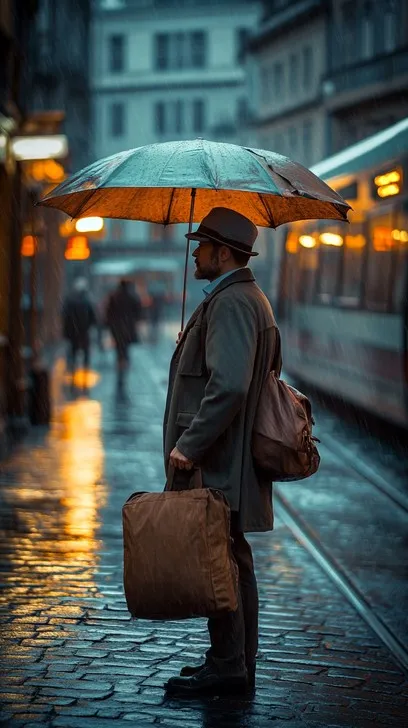
Photo: Rainofficial2022, CC BY-SA 4.0, via Wikimedia Commons
There is a particular moment familiar to every leather owner in Britain. You step off the train at Manchester Piccadilly, or out of a pub in the Lake District, and the sky — which had been merely grey all morning — commits itself entirely. Within seconds your jacket or bag is darkening at the shoulders, and your first instinct is to scrub at it with a sleeve.
Resist that instinct. What you do in the next ten minutes matters far more than what the rain did in the last ten.
Why British Rain Is a Genuine Test
Our weather is uniquely unkind to leather, though rarely dramatically so. A tropical downpour arrives and departs; a British drizzle lingers for hours, keeping hides damp all day. Persistent moisture, combined with the chill that stops leather drying properly overnight, is what separates a jacket that weathers beautifully from one that stiffens and spots.
Not all leathers respond the same way, and knowing yours is half the battle.
Full-Grain: The Most Forgiving Traveller
Full-grain leather, particularly vegetable-tanned hide with a proper wax or oil finish, is the sailor of the family. Its dense, intact surface sheds water for a surprisingly long time — long enough, in most cases, to reach shelter without consequence.
When it does get wet, expect a temporary darkening. This is not damage; it is the hide drinking, exactly as nature intended. Once dry, most quality full-grain returns to its original tone. Some owners even come to prize these marks — a map of every soaking, from a downpour on the Pennine Way to an ill-advised dash across Princes Street.
What to do: blot gently with a soft, absorbent cloth, then let it dry naturally, away from radiators and direct heat. Once fully dry, a light reconditioning restores the oils the water displaced.
Suede and Nubuck: Handle With Genuine Care
Suede is a different proposition altogether. Its brushed, open nap absorbs water almost immediately, and a soaked suede jacket can emerge from a wet weekend looking two sizes larger and several shades darker.
The good news: with patience, most suede recovers. The danger is interference. Rubbing wet suede crushes the nap and creates permanent shiny patches; heat from a radiator or hairdryer will stiffen it irreversibly.
What to do: shake off excess water, blot — never rub — with a clean towel, then stuff the garment with paper and leave it to dry slowly at room temperature, ideally in a well-ventilated hallway rather than a steamy kitchen. Once bone-dry, brush the nap gently with a suede brush to lift it back to life. A quality suede protector spray, applied in autumn and again in spring, is the best £10 you will spend.
Patent: The Fair-Weather Friend
Patent leather, with its lacquered surface, is entirely waterproof in the short term — rain simply beads off. Its weakness is not the water but the damp heat that follows. Left in a wet, enclosed space, the finish can crack or the layers beneath can swell.
What to do: wipe with a barely damp cloth, dry with a soft towel, and give it air. Never store patent items wet in a bag or car boot overnight.
The Sleeve-Wipe Problem
Why is the instinctive wipe so harmful? Three reasons. First, the friction of a wool cuff or denim sleeve grinds surface water and any grit it carries into the grain. Second, spreading water thinly across the leather enlarges the area that darkens and spots. Third — and most damaging — the panic-wipe is usually followed by the panic-rub near a radiator, which dries the hide too quickly and causes it to crack.
A calm blot, patience, and air. That is the whole discipline.
Water Spotting: Damage or Character?
Here is the question that divides collectors. Small, even darkening across a waxed full-grain jacket — the sort that fades into a general patina — is character, and arguably the entire point of owning hide that ages. A hard-edged pale ring on smooth leather, left by a raindrop drying against a contaminated surface, is a blemish, and one best treated early with a dedicated leather cleaner before it sets.
The distinction is simple: gradual and uniform reads as story; sharp and isolated reads as accident.
A Closing Thought for the Season
Carry the umbrella, by all means. But do not fear the day it fails. A well-made leather garment, treated with a little knowledge and a little patience, will shrug off a thousand British downpours — and carry the memory of every one of them with dignity.