The Commute Is Crueller Than the Climate: How Daily Habits Undo a Good Leather Bag
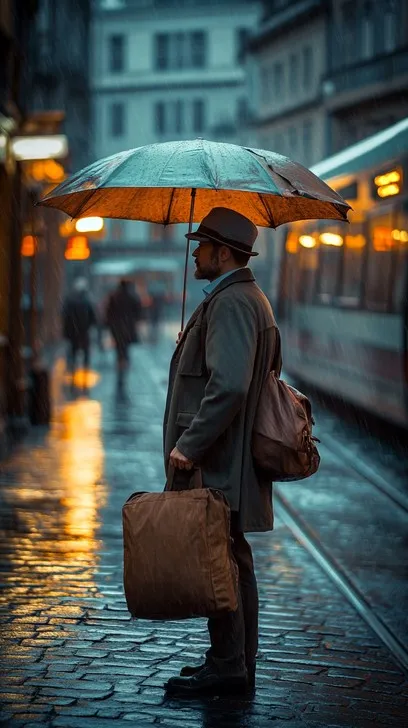
Photo: leather bag commuter rainy London street umbrella, via images.stockcake.com
There is a particular kind of British self-deception that takes place in the leather goods department every autumn. A customer, having invested properly in a beautifully made bag, will then confess — almost apologetically — that they are also buying something cheaper, 'just for commuting'. The good bag, they explain, is for best. The cheap one is for the daily grind.
It is a sensible-sounding arrangement, and it is almost entirely backwards. In four decades of watching leather come and go, we have observed that the weather ruins remarkably few bags. The commute, by contrast, is merciless.
The Weather Gets the Blame; the Radiator Does the Damage
Consider the sequence. A bag is caught in a proper downpour — the sort that turns a Tuesday in Manchester into a maritime event. The owner arrives home, does the instinctive thing, and sets the bag beside the radiator to dry. Within hours, that gentle warmth has drawn moisture out of the hide faster than it should leave, leaving the leather stiff, dull and prone to cracking along the fold lines.
Rain, properly managed, is a nuisance. Direct heat is a catastrophe. A soaked bag should be emptied, blotted with a dry cloth, stuffed loosely with newspaper, and left to dry naturally — slowly, patiently, away from every heat source in the house. The British weather is survivable. British central heating, applied thoughtlessly, is not.
The Umbrella Test
We have taken to calling it the umbrella test. Watch any crowded pavement at the first spitting of rain and you will see it: a forest of cheap umbrellas snapping open at eye level, each one a small spiked hazard. The bag worn at the hip takes the brunt — a puncture here, a deep scratch there — inflicted not by the storm but by the defensive apparatus we carry against it.
It is a small thing, but it illustrates a wider truth. The threats to a quality bag are rarely dramatic. They are cumulative, domestic and absurdly mundane.
A Field Guide to Quiet Destruction
Beyond the radiator and the brolly, the everyday commute conducts its own slow campaign:
- The overfilled tote. A bag designed to carry a working day should not carry a working week. Overloading stretches straps beyond their intended tension, distorts the structure and, on a full-grain bag, permanently widens the handle attachment points. If the strap creaks when you lift it, the bag is filing a complaint.
- The bus-seat scuff. Coated fabrics on public transport seating are abrasive by design. A bag slung casually against one collects a fine haze of scratches over months. Resting it on your lap costs you nothing.
- The floor deposit. Pubs, trains, office lifts — the floor is where bags go to gather grit, moisture and the heel of somebody else's shoe. Hooks exist. Use them.
- The fortnightly wipe. Or rather, the absence of one. City grime works into the grain and dulls the finish. A soft, barely damp cloth once a week does more than any annual conditioning marathon.
The Rituals Checklist
None of this requires devotion. It requires habit. We suggest the following, which takes less than five minutes a week:
- Empty the bag properly once a week. Crumbs, receipts and forgotten coins abrade the lining from the inside.
- Wipe down with a dry or barely damp cloth — never household sprays, which strip the finish.
- Condition quarterly with a quality cream, applied sparingly and buffed. Leather is skin; it dries out, particularly in winter.
- Store it stuffed and breathing — a cotton pillowcase, never plastic, in a wardrobe with air around it.
- Rotate. Even the finest bag needs a day off. Two good bags alternating will outlast one good bag used daily.
Own It, Don't Archive It
There is a final irony worth naming. The 'good bag for best' often deteriorates faster than a well-used one, because leather that sits unused in a dry wardrobe stiffens and fades unevenly, while leather that is carried, flexed and cared for develops the patina that justifies the purchase in the first place.
So by all means carry the good bag on the 8:14. Buy the decent umbrella. Keep it off the radiator. A properly made bag is not a hothouse flower — it is a working animal, bred for exactly this climate and this commute, provided you extend it the small courtesies described above. Do that, and in ten years it will look better than the day you bought it. Which, we would gently suggest, is the entire point.