The Tannery Decides: Understanding Chrome and Vegetable Tanning Before You Spend a Penny
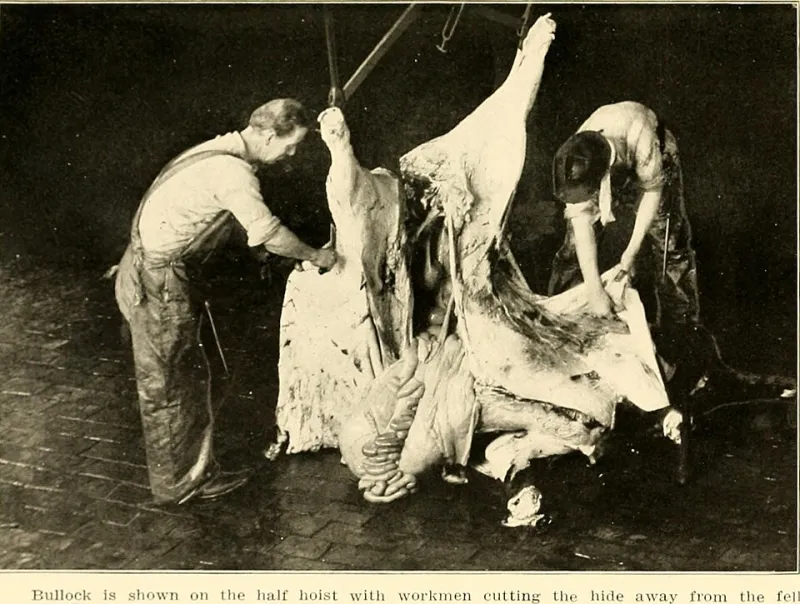
Photo: Internet Archive Book Images, No restrictions, via Wikimedia Commons
Ask a sales assistant why one leather jacket costs £400 and another £900, and you will rarely hear the word that matters most: tannage. Brands, linings and stitching all have their place, but the single greatest determinant of how a leather piece will behave — how it softens, how it weathers, how long it lasts — is decided weeks before a needle touches hide, in the tannery.
There are two dominant methods in use today: chrome tanning and vegetable tanning. Understanding the difference will do more for your next purchase than any amount of label-reading.
What Tanning Actually Does
A raw hide is, bluntly, a perishable material. Left untreated, it would stiffen, rot and return to the earth. Tanning converts collagen fibres into a stable material that resists decay — permanently, if done well. The agent used to achieve this transformation defines the leather's character for the rest of its life.
Chrome Tanning: Speed and Softness
Chrome tanning, developed in the mid-nineteenth century and industrialised widely by the twentieth, uses chromium salts to stabilise the hide in as little as a day. The result is a soft, supple, water-resistant leather produced quickly and cheaply at scale. Most leather in the world today — by some estimates upwards of 80 per cent — is chrome-tanned.
Its virtues are genuine. Chrome-tanned jackets break in quickly, drape beautifully from the first wear, and resist rain rather well — no small consideration on a British Tuesday. It is also the method behind most aniline-dyed, heavily finished leathers that arrive looking flawless.
Its drawbacks emerge with time. Chrome leather tends to plateau: it softens, but it does not develop the deep patina of its vegetable-tanned cousin. And chromium, if managed carelessly by a tannery, poses genuine environmental and disposal challenges — a point worth raising with any maker claiming green credentials.
Vegetable Tanning: Patience Made Material
Vegetable tanning is the older craft by two thousand years or more. Tree barks — oak, mimosa, chestnut — are ground into tannin-rich liquors, and hides soak in them for weeks, sometimes months. The resulting leather is firmer, richer in tone, and extraordinarily responsive to the life of its owner.
Vegetable-tanned leather darkens, burnishes and records every scuff. A satchel bought in chestnut at twenty-five may be a deep mahogany at fifty. It also ages repairably: the leather can be re-fed, re-waxed, even re-dyed, which is why well-kept vegetable-tanned pieces routinely outlive their owners.
The trade-offs are real. It costs more, it takes longer, and it is less naturally water-resistant — a jacket caught in a Lake District downpour will need proper drying and reconditioning afterwards.
Why the Price Gap Should Make Sense
Return to our £400 versus £900 jacket. If the £900 piece is vegetable-tanned full-grain hide from a British tannery, you are paying for raw material, slow process and domestic craft — and you are buying a garment that will still be improving in 2050. If the £400 piece is well-made chrome-tanned leather, it may still be a perfectly sensible purchase: softer out of the box, easier in the rain, and honest about what it is. The mistake is not choosing either; it is not knowing which you are choosing.
How to Tell in the Shop
You need not be an expert — you need only ask and observe.
Ask directly. "Is this vegetable-tanned or chrome-tanned?" Any reputable British maker will answer without hesitation. Vagueness is itself an answer.
Smell the leather. Vegetable-tanned hides carry a woody, faintly sweet aroma. Chrome leather smells more neutral, sometimes faintly chemical.
Look at the edge and the surface. Vegetable-tanned leather shows natural grain, insect marks and tonal variation. A perfectly uniform surface usually indicates heavy finishing — common on chrome-tanned goods.
Test the flex. Vegetable-tanned leather resists slightly, then settles. Chrome leather yields immediately.
The Questions Worth Asking a British Maker
Beyond tannage, three questions separate the serious from the superficial. Where was the hide tanned — and by whom? What finish, if any, has been applied? And how should the piece be maintained over the first five years? A maker with pride in their tannery relationships will relish these questions. One who does not has told you everything you need to know.
The tannery decides how leather begins. You decide how it lives. Choose with both facts in hand, and whichever tannage you settle on, it will serve you honestly for decades.