One Wallet, Forty Years: The Shoebox Lessons Our Grandparents Never Wrote Down
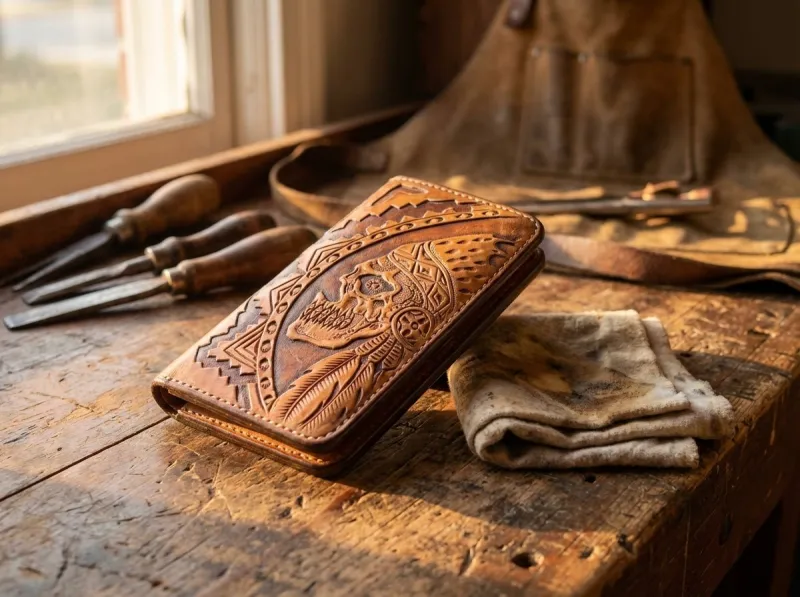
Photo: vintage leather wallet and belt worn patina on wooden table, via cdn.shopify.com
Somewhere in most British families there is a shoebox. It sits at the back of a loft, or at the bottom of a wardrobe in a house long since cleared, and it holds a small treasury: a billfold worn smooth at the fold, a belt whose buckle has been replaced twice, a handbag with a repaired strap and a patina no factory could imitate. These objects were not part of a collection. They were simply the ones owned.
The Arithmetic of Possession
Consider what our grandparents actually carried. One wallet, kept until the stitching gave out — and then repaired, because the stitching giving out was not a reason to replace it. One good belt. One bag for Sunday best, one for the rest. A man who worked at the steelworks in Sheffield or the docks in Liverpool might own, across his entire adult life, fewer leather goods than a modern shopper browses in a single evening.
This was not asceticism. It was arithmetic. Leather was expensive relative to wages, and so it was bought the way a house was bought: deliberately, once, with an eye to the long term. The objects that survived into those shoeboxes survived because they were made to be repaired and because their owners expected nothing less.
What the Patina Is Actually Telling You
There is a fashion for describing patina as character, and it is a fair description — but the shoebox teaches a stricter lesson. The shine on a grandfather's wallet is a record of use, not of storage. The darkest wear appears where the hand gripped; the softest corners are the ones that rested in a pocket for four decades. These were working objects, and the leather improved because it worked.
The implication for the modern buyer is uncomfortable but clarifying: a piece you wear twice a year will never develop this. A wardrobe of occasional leather is a wardrobe of objects frozen at their least interesting moment. Better one jacket worn weekly through a Yorkshire winter than five kept flat in garment bags, waiting for occasions that do not arrive.
The Shoebox Wardrobe
We would argue for a return to what might be called the shoebox standard: if your entire leather collection would not fit in a shoebox — or at most a small trunk — you likely own too much and know too little about any of it. The test is not literal, but the principle holds. A considered collection for a man or woman in their thirties or forties might look like this:
- One jacket, full-grain, in a colour that works with everything you already own. Buy it once, properly fitted, and expect to resole — or rather, reline and repair — it for decades.
- One belt in a shade that matches your everyday shoes, and let it be a good one. A belt is the most visible leather you wear after the shoes themselves.
- One bag or briefcase suited to your actual working life, not your imagined one.
- One wallet, replaced perhaps twice in a lifetime.
- One pair of boots or shoes worth having resoled rather than replaced.
That is six or seven objects. Their quality can be high precisely because their number is small.
Starting Late, Starting Well
There is a common anxiety that the shoebox wardrobe is only available to those who inherited it — that the good leather must come from a grandfather. Not so. Your thirties and forties are, in truth, the ideal moment to begin. You know by then which colours you actually wear, whether you carry a laptop or a newspaper, and which of your habits destroy accessories. You have, in other words, the information that makes a permanent purchase possible.
Begin with the piece you use daily, because that is the piece whose quality you will notice — and whose repair you will learn from. Find a cobbler or repairer before you need one; most market towns still have one, and the good ones are worth crossing a county for. Ask the maker questions about stitching, lining and hardware before you ask about price. A piece intended to last forty years should be judged on its fortieth, not its first.
Buying Less as a Form of Respect
There is a final argument, and it is not about money. When a wallet is carried for forty years, the maker's work is honoured for forty years. When the same quality of hide is bought, worn a season and discarded, that same craftsmanship is squandered — however fine the object. Buying less is not merely thrift. It is the only honest way to buy things made well.
The shoebox in the loft was never a museum. It was a waiting room: those objects were kept because someone intended to pass them on. Build a collection small enough and good enough that someone, someday, will open a box and find yours.