Twelve Measurements and a Conversation: Inside a Made-to-Measure Leather Fitting
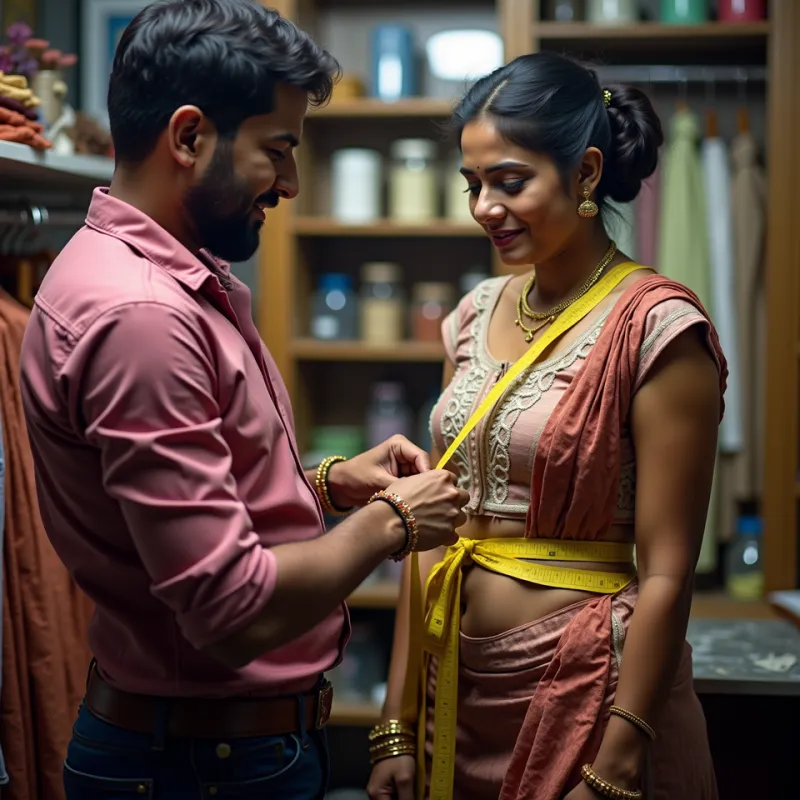
Photo: Generated using FLUX 1.0 model using Forge UI, Public domain, via Wikimedia Commons
There is a moment in every bespoke fitting that no photograph quite captures: the cutter circling the customer with a tape measure, saying very little, occasionally asking them to lift an arm or roll a shoulder. To the untrained eye it looks routine. In truth, the cutter is reading the body the way a tanner reads a hide — looking for the points of tension, the asymmetries, the truths that off-the-peg sizing will never accommodate.
We recently followed one jacket through the entire made-to-measure process at a British workshop, from first appointment to final collection. What struck us most was not the craft itself, though the craft is considerable. It was how much of the process is built around a simple fact: leather does not forgive a poor fit the way cloth does.
Why Fit Matters More in Leather
A wool jacket can be taken in, let out, even partially rebuilt by a competent tailor. Leather cannot. Every seam line is a permanent scar in the hide; every needle hole is there for good. If a panel needs replacing, the patina and character of the surrounding leather will never quite match. Alteration, in leather, is mitigation rather than correction.
This is why the fitting stage matters so much. Leather also behaves differently on the body. It has weight, and it softens and moulds with wear in a way woven cloth does not. A jacket cut correctly will relax into the wearer's posture over a season. A jacket cut wrongly will pull at the shoulders and bag at the elbows forever.
The First Appointment
The process begins with a conversation as much as a measurement. The cutter will ask how the customer intends to wear the jacket — over a suit, over a jumper, on a motorbike — because a millimetre of ease at the chest is the difference between a jacket that layers and one that binds.
Then come the measurements: typically a dozen or more, from neck to wrist, chest to hem, along with observations that never appear on any form. One shoulder a touch lower than the other. A slight forward carriage in the stance. These are the details that separate made-to-measure from merely well-chosen.
Cutting and Construction
The hide selection follows. A cutter will lay the pattern pieces to work with the hide's natural shape, placing the firmest leather across the shoulders and the softest where movement is greatest. Panels are cut by hand — never stacked, as with cloth — because no two hides are alike.
Stitching proceeds slowly. A quality jacket may take a full working week or more between first cut and final press, much of it spent on the small things: reinforced bartacks at pocket corners, seams skived so they lie flat, edges dressed and burnished by hand.
The Second Fitting
Most workshops hold the jacket back at what is called a basted or skeleton stage — loosely assembled — for a second fitting. Here the customer tries the garment while it can still be adjusted, and the cutter checks the balance across the shoulders, the drape at the back, the length of the sleeves with the arm relaxed.
Adjustments at this stage are small but decisive: a centimetre off the sleeve, a fraction taken from the back seam. Once final stitching goes in, the room for manoeuvre is largely gone.
When Is Bespoke Worth It?
Honesty is due here: not everyone needs made-to-measure. If you wear a standard size, have conventional proportions, and plan to wear the jacket casually, a well-cut ready-to-wear piece from a reputable maker will serve you admirably.
Bespoke earns its cost in three circumstances. First, when your proportions fall outside the standard pattern — long arms, a short back, broad shoulders with a narrow waist. Second, when the jacket is intended as a lifelong purchase, the kind of piece discussed in inheritance terms rather than seasonal ones. Third, when you want specific things — a particular hide, a particular lining, a pocket placed exactly where your hand falls — that no factory line will offer.
For everyone else, the value of understanding the bespoke process remains, even if you never commission one. Once you have seen what a cutter measures and why, you will never look at an off-the-peg jacket the same way again. You will check the balance in the mirror, notice where it pulls, and understand that somewhere, in a workshop in this country, someone could have fixed it — before the first stitch was ever made.