Mend First: The Quiet Rise of the Leather Repair Café
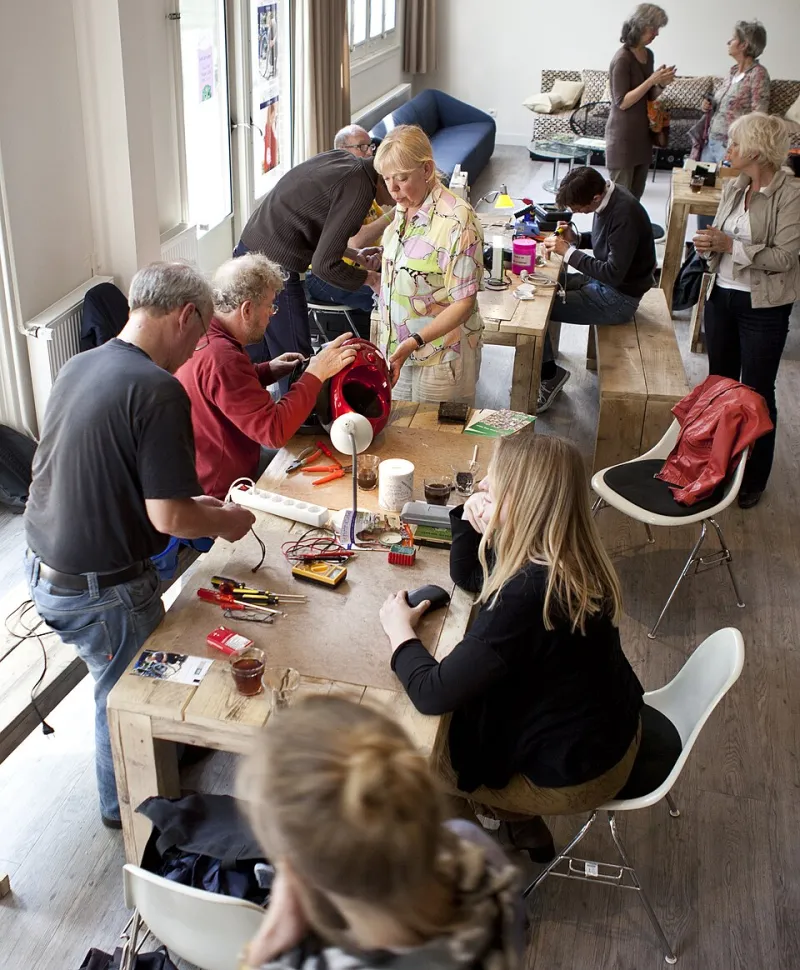
Photo: Ilvy Njiokiktjien, CC BY-SA 3.0, via Wikimedia Commons
On a Saturday morning in a church hall, a library or a community centre, a familiar scene is spreading across Britain. Someone arrives with a jacket under one arm and a bag in the other. A volunteer looks at the zip, the lining, the strap. A specialist mender gives an honest verdict. The repair café has come for leather, and in 2026 that is good news for anyone who has priced a replacement lately.
The quiet growth
The repair café movement is not new, but its leather work is. Across the UK, local groups have added textile and leather menders to their volunteer lists. Some sessions are general: a broken lamp, a torn coat, a wobbly chair. Others are specialist, hosted by cobblers, bag repairers or leather workshops. The common thread is a simple offer: bring what you have, learn what can be done, and pay for parts or a small donation rather than a new item. In a year of rising prices and environmental scrutiny, that offer has found a ready audience.
What a repair café can realistically fix
A repair café is not a restoration house. It is a triage service with skilled hands. The jobs that suit it best are the ones that are mechanical rather than structural: a failed zip, a broken buckle, a loose press stud, a strap that has come away at one end, a lining seam that has opened, a worn edge that needs re-colouring. A cobbler can replace a zip on a bag or a jacket, though matching a heavy-duty zip takes time and parts. A leather mender can re-stitch a handle root or patch a small tear. Some sessions offer conditioning and cleaning advice, though deep restoration is usually beyond the scope of a two-hour volunteer slot.
What it cannot fix is leather that has failed as a material. If the hide is cracked through, if bonded leather is peeling, if mould has eaten into the structure, no amount of stitching will save it. A repair café should tell you that plainly. That honesty is part of the service. The question is not whether every item can be saved, but whether the item you own is worth saving.
Judging whether to mend or replace
Start with the leather itself. Full-grain and top-grain leather can often be repaired because the fibres are still sound. Corrected-grain leather can be repaired too, but the finish may need specialist attention. Bonded leather — the compressed leather dust that appears in cheaper goods — is usually a false economy; once it peels, it keeps peeling. Next, look at the structure. A jacket with a failed zip is a straightforward repair. A jacket with a torn shoulder seam and rotting lining is a bigger question. A bag with a broken handle is usually worth fixing. A bag with a cracked gusset and a torn lining may cost more to repair than to replace.
Then consider cost and sentiment. A repair that costs a third of a replacement is usually worth doing, especially if the item fits well and the leather is good. A repair that costs two-thirds of a replacement needs a harder look. Sentiment is allowed to count. A jacket inherited from a parent, a bag bought on a first trip, a belt that has been to every wedding — these are not rational calculations, and they do not need to be. The point of mending is not to pretend that money does not matter. It is to recognise that replacement is not always the cheaper or better answer.
Where to start
Find your local repair café through the Repair Café UK network, your council's waste team, or a noticeboard in a library or community centre. Ask what they can handle before you go. Photograph the damage in daylight. Bring any spare parts you have: a replacement zip, a buckle, a length of matching thread. Be prepared for a volunteer to say no, or to refer you to a specialist. For valuable or sentimental pieces, go directly to a leather mender or bag spa rather than a general session. A good mender will tell you what is possible, what it will cost, and whether the repair will last.
In 2026, the case for mending is practical as well as principled. Leather prices have risen, landfill is scrutinised, and the best-made items are the ones that were designed to be repaired. The repair café is not a cure for everything. But it is a sensible first stop before the bin, and a reminder that a well-made leather item is not a disposable product. Mend first. Replace only when the leather itself has given up.